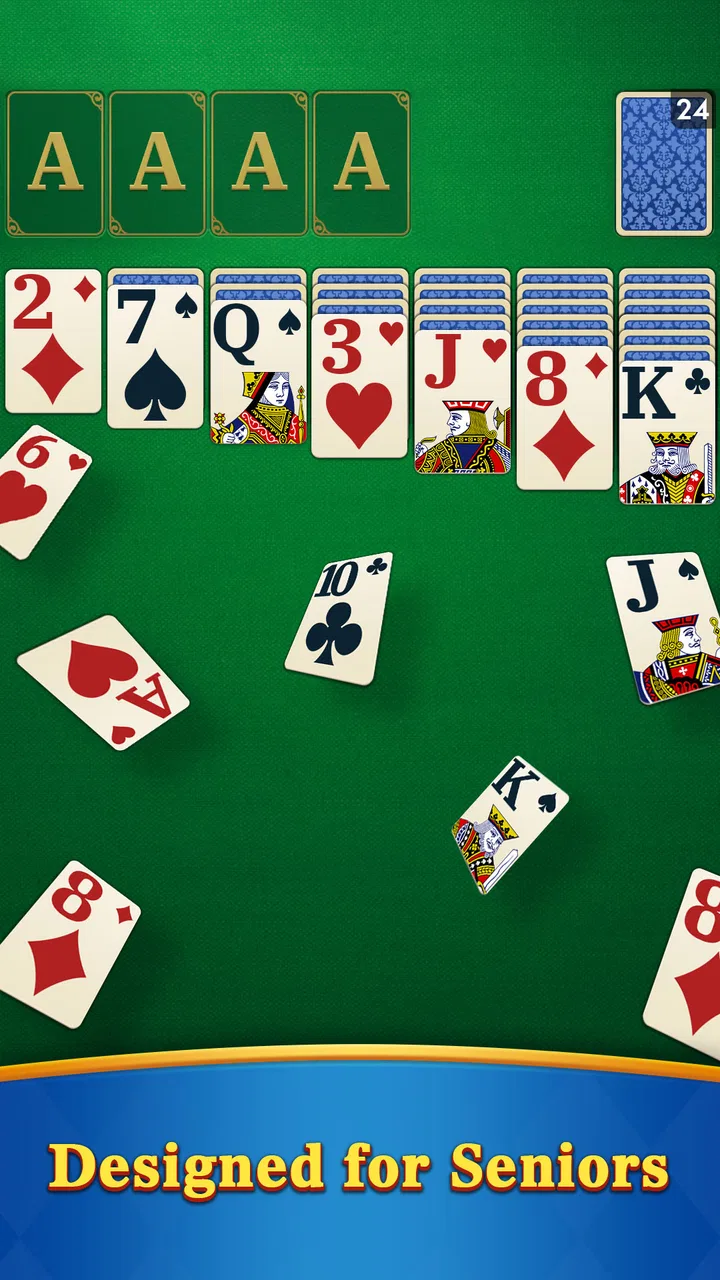
Solitaire Master - Card Game
- 4.5
- Rating
- 1.00M
- Installs
- Free
- Price
 Analysis by App-foxy
I spent time with Solitaire Master as a quiet, pick-up-and-play card game, and my first impression was simple: it understands why people still return to solitaire. A round can fit into a short break, yet the basic decisions still give me something to think about. It is free, aimed at Everyone, and comes from intense dev, so it is easy to approach without treating it like a large, complicated game.
The important thing is that this is not a dramatic reinvention of card games. Its appeal comes from giving the familiar solitaire format a cleaner, more focused place on a phone. The store summary calls it a fresh take on traditional solitaire card games, but I would describe the experience more carefully: it keeps the recognizable rhythm while trying to make each session feel purposeful. That makes it a sensible choice for players who want cards rather than a busy collection of unrelated activities.
How the first sessions establish a rhythm
The opening experience is easy to understand because solitaire explains itself through the layout. I do not need a long tutorial to know that I should look for useful moves, expose hidden cards, and avoid closing off options too early. That low barrier matters on mobile, where a game that demands too much setup quickly loses its place in my daily routine.
You May Also Like

 Blood Strike: 2.5 Anniversary
Blood Strike’s Loadouts Turn Every Drop Into a Tactical Gamble
A close look at Blood Strike’s custom loadouts: how fast access to signature weapons reshapes its battle royale rhythm, rewards preparation, and narrows the gap between fights.

 Pandora - Music & Podcasts
Pandora’s Music Is Easy to Start, but Harder to Recover
Pandora’s strength is its low-effort path from a seed to a station. Its weak spot is how much confidence it asks you to place in connection, setup, and quiet recovery.

 8 Ball Pool
 Is Built on Rivalries, Rematches, and Routine
A close look at the rivalries, rematches, shared routines, and unanswered safety questions that turn a quick pool match into a persistent mobile community.

 Samsung Music
’s Quiet Strength Is Playing What You Already Own
Its reach comes less from spectacle than from dependable access to a personal library. That simplicity is both the app’s strongest retention engine and its ceiling.

 AccuWeather: Weather Radar
AccuWeather Review: A Quick, Clear Forecast for Everyday Decisions
For everyday plans, the best forecast is the one you can understand quickly. AccuWeather makes rain timing, radar, and local conditions easy to act on, with a few trade-offs.

 Hill Climb Racing
Why Hill Climb Racing Still Turns Crashes Into One More Run
A tiny car, a bumpy hill and one more upgrade: Hill Climb Racing keeps resurfacing because its simple chaos makes every near-miss feel personal.
More From Our News Desk



My early goal was not simply to finish a hand. It was to learn how the game rewards patience. A move that looks attractive immediately can sometimes be less valuable than opening a concealed card or preserving a column for later. That small tension gives the familiar format more weight than a purely automatic card-matching exercise.
For a new player, the best approach is to treat the first few rounds as practice in reading the board rather than as tests of speed. I found it more useful to scan for moves that reveal information before committing to moves that only improve the visible arrangement. That habit is one of the first meaningful lessons the game offers, and it remains useful after the layout stops feeling new.
The game works particularly well in everyday situations where I have only a few uninterrupted minutes. I can imagine opening it while waiting for an appointment, taking a short break from work, or winding down before bed. It does not require the social coordination of a multiplayer card game, and it does not ask me to remember a large story or a complicated control scheme. The commitment is small, which is exactly what I want from this type of solitaire.
At the same time, players looking for a strong opening campaign may find the beginning restrained. The attraction is the card puzzle itself, not a narrative introduction or a large cast of characters. If your idea of early progression involves dramatic rewards, elaborate missions, or constant new mechanics, this is a more modest experience.
What progress feels like during ordinary play
Progress in a solitaire game is often less about a visible adventure map and more about improving the quality of my decisions. A successful round gives me a clear sense that I read the layout correctly. A failed round can still be useful when I understand which choice reduced my options. That makes the game’s progress feel personal rather than purely numerical.
I also noticed that repeated play can sharpen a practical routine. I begin by checking moves that uncover hidden cards, then consider whether a transfer will create another opening, and only afterward worry about tidying the visible stacks. This order is not a magic solution for every hand, but it prevents the common mistake of making a move simply because it is available.
That is one of the less obvious strengths here: the game can serve as a small concentration exercise without pretending to be a productivity tool. I am not multitasking while playing. For a few minutes, I am looking at one arrangement, weighing consequences, and accepting that some hands will not resolve the way I want. The benefit is subtle, but it gives the familiar format a reason to stay installed.
The published audience response also suggests that the game has found a substantial audience. It holds an average rating of 4.5 from around 61 thousand ratings, with roughly 2.1 thousand written reviews and over a million installs. Those figures do not replace personal experience, but they do make the game easier to take seriously than an obscure card title with little evidence of ongoing use.
One practical question is whether the game is genuinely free to start. It is listed as free, which removes the main barrier for someone who only wants to try a few hands. I would still advise approaching it as a focused card game rather than assuming that “free” means it will satisfy every preference found in paid solitaire collections. The value here is the immediate accessibility and repeatable play, not a promise of a huge premium package.
Where the challenge comes from
The difficulty curve in Solitaire Master is best understood through decision quality rather than reflexes. I never feel that faster tapping is the main path to success. The challenge comes from recognizing which cards should move now, which should wait, and which apparent improvement may make the remaining layout harder to manage.
That pacing is a good fit for players who like calm pressure. The game does not need to shout at me to create tension. A nearly organized board can still become awkward when one important card remains buried. Conversely, a messy-looking layout can suddenly open up after one well-chosen move. Those reversals keep the hands from feeling completely mechanical.
My strongest advice is to avoid spending every available move immediately. Before moving a card, I try to ask what the move creates rather than what it fixes. Does it expose something hidden? Does it free a space? Does it preserve a useful sequence? If the answer is no, waiting can be smarter than tidying. This is the kind of trade-off that separates a thoughtful session from random tapping.
Another useful habit is to pause after every newly exposed card. The temptation is to continue along the first promising line, but the new information can change the best choice. I found that short pause especially valuable when I was playing casually and was otherwise inclined to move on autopilot.
The trade-off is that solitaire naturally includes situations where the outcome can feel less controllable than in a pure logic puzzle. If I want every failure to be traceable to one clearly wrong decision, this format may occasionally frustrate me. The game is more enjoyable when I accept that the aim is to make the strongest choices available, not to force certainty from every layout.
That also explains who should skip it. Players who need rapid action, direct competition, character progression, or a strong sense of unlocking new content may find the pace too quiet. A dedicated puzzle game may be better for someone who wants fixed, explainable solutions, while a multiplayer card title may suit someone who needs opponents and social pressure. Solitaire Master is for the player who enjoys a private contest against a changing arrangement.
Does the loop keep me coming back?
The retention loop is understated. I return because a short hand is easy to begin, and because the next layout gives me another chance to make better choices. That is a healthier kind of repetition than a game that constantly interrupts play with demands for attention. I can stop after one round without feeling that I have abandoned a long chain of tasks.
There is also a useful difference between playing for completion and playing for improvement. On a busy day, I may simply want the calm of arranging cards. On a more focused day, I may replay the same general style of decision-making with the goal of reducing careless moves. The game supports both moods because the core activity remains understandable even when I am not trying to optimize it.
However, the restrained design can also limit long-term motivation. Without a strong personal interest in solitaire, I may eventually feel that I have seen the main idea. The game’s staying power depends on whether the card decisions themselves remain satisfying for me. I would not recommend it to someone who needs frequent surprises to stay engaged.
For me, the best use case is a repeatable daily pause. I might play one hand after finishing a task, then close the game before it turns into an hour of passive scrolling. Because the rounds are self-contained, it is easier to set that boundary than with games built around continuous worlds or escalating missions.
One question many phone users have is whether the experience is suitable for a wide range of ages. Its content rating is Everyone, and the card format is straightforward enough for family-friendly casual play. That does not mean every player will enjoy the same level of challenge, but it does make the game approachable for people who want something uncomplicated and non-confrontational.
Small habits that make the game better
I recommend using a deliberate opening scan instead of immediately following the most obvious move. Look first for cards that reveal something underneath them, then check whether the move will leave a useful space or sequence behind. This takes only a moment, yet it changes the game from a series of reactions into a chain of choices.
When the board becomes crowded, I find it helpful to stop trying to improve every visible stack at once. Choose one priority: expose hidden information, create room, or preserve a sequence. Switching priorities after every move can make the layout harder to read. Keeping one clear objective makes the hand feel less chaotic.
I also suggest treating a failed hand as a review rather than an immediate reason to quit. Ask which move first reduced the number of useful options. Sometimes the mistake is not the final move that caused the loss, but an earlier decision that looked harmless. This turns repetition into learning and gives the game more depth than its simple presentation suggests.
A final practical tip is to play when you can give the board modest attention. Solitaire is easy to pause mentally, but distracted play encourages automatic moves and makes the result feel arbitrary. A short, focused session is usually more satisfying than a longer session interrupted by messages, conversation, or other tasks.
Device fit, accessibility, and expectations
The game runs on Android devices using version 7.0 or later, which covers a broad range of phones and tablets. That makes it a practical option for someone who does not have a recent flagship device. I would still judge the experience on the comfort of the screen and touch controls, because card games depend heavily on being able to distinguish and select cards without hesitation.
The current version is 1.0.19, and the game was released on November 14, 2024. Those details place it as a relatively recent entry rather than an old classic that has simply been left in an app store. For a potential user, the more important takeaway is that it presents itself as a focused modern option while keeping the rules familiar.
I would choose it over a sprawling solitaire suite when I want one clear activity without sorting through many modes. I would choose a more established alternative when I need a particular traditional variant, extensive customization, or a deeper collection of formats. The choice depends on whether simplicity feels refreshing or limited.
The same comparison applies to paid card games. A paid option may be preferable for someone who wants a carefully curated, distraction-free package and is willing to pay upfront. Solitaire Master makes more sense when I want to begin without that commitment and decide through actual play whether the basic loop suits me.
My verdict on its progression and staying power
Solitaire Master succeeds because its goals are immediate and understandable: read the layout, make careful choices, and complete the hand when the arrangement allows it. Its progress signals come from better judgment and successful resolutions rather than from a loud progression system. The difficulty grows through the pressure of limited options, while the pacing remains gentle enough for short sessions.
That approach will not satisfy everyone. I would skip it if I were searching for elaborate unlocks, competitive matchmaking, or a game that constantly introduces new systems. I would also avoid expecting every loss to feel perfectly fair or every session to deliver a dramatic sense of achievement. This is a quiet card game, and its strengths are tied to that modest ambition.
For the right player, though, that restraint is the point. I can open it without preparation, play a hand during an ordinary pause, and leave with the feeling that I spent those minutes on something focused. The game is free, accessible to Everyone, and supported by a sizeable audience, but I value it most for the simple discipline it encourages: look ahead, protect your options, and do not confuse an available move with a good move.
My recommendation is therefore straightforward. Try it if you want a familiar solitaire foundation with a slightly fresher presentation and enough decision-making to keep the cards from becoming completely automatic. Skip it if you need a rich progression structure or constant novelty. For casual players who enjoy calm, repeatable card puzzles, Solitaire Master is an easy game to keep nearby and return to whenever a few quiet minutes appear.
FAQs for Solitaire Master - Card Game
01What platforms is Solitaire Master - Card Game available on?
Solitaire Master - Card Game is available for both Android and iOS devices. You can download it from the Google Play Store for Android or the Apple App Store for iOS. The game is optimized for smartphones and tablets, ensuring a smooth experience across different devices.
02Is Solitaire Master - Card Game free to play?
Yes, Solitaire Master - Card Game is free to download and play. However, it does offer in-app purchases for additional features, themes, and power-ups. These purchases are optional and not necessary to enjoy the full game experience, but they can enhance gameplay and provide additional customization options.
03Does Solitaire Master - Card Game require an internet connection?
No, Solitaire Master - Card Game can be played offline. You do not need an internet connection to enjoy the classic solitaire gameplay. However, an internet connection is required for downloading updates, accessing leaderboards, and making in-app purchases if desired.
04Are there different modes available in Solitaire Master - Card Game?
Yes, Solitaire Master - Card Game offers a variety of modes to keep players engaged. You can play the classic Klondike version, explore daily challenges, or participate in timed events. Each mode offers unique challenges and rewards, catering to both casual players and those seeking more competitive gameplay.
05How does Solitaire Master - Card Game handle ads?
Solitaire Master - Card Game includes ads to support its free-to-play model. Ads may appear between games or offer optional rewards like extra hints or moves. If you prefer an ad-free experience, you can purchase the premium version or a subscription to remove ads and enjoy uninterrupted gameplay.
Pros
- Smooth and intuitive interface
- Wide variety of solitaire modes
- Daily challenges for rewards
- Offline play available
- Minimal ads for free version
Cons
- Limited customization options
- Occasional in-app purchase prompts
- No multiplayer features
- Some modes locked behind paywall
- Battery drain on older devices

Solitaire Master - Card Game
Gallery